
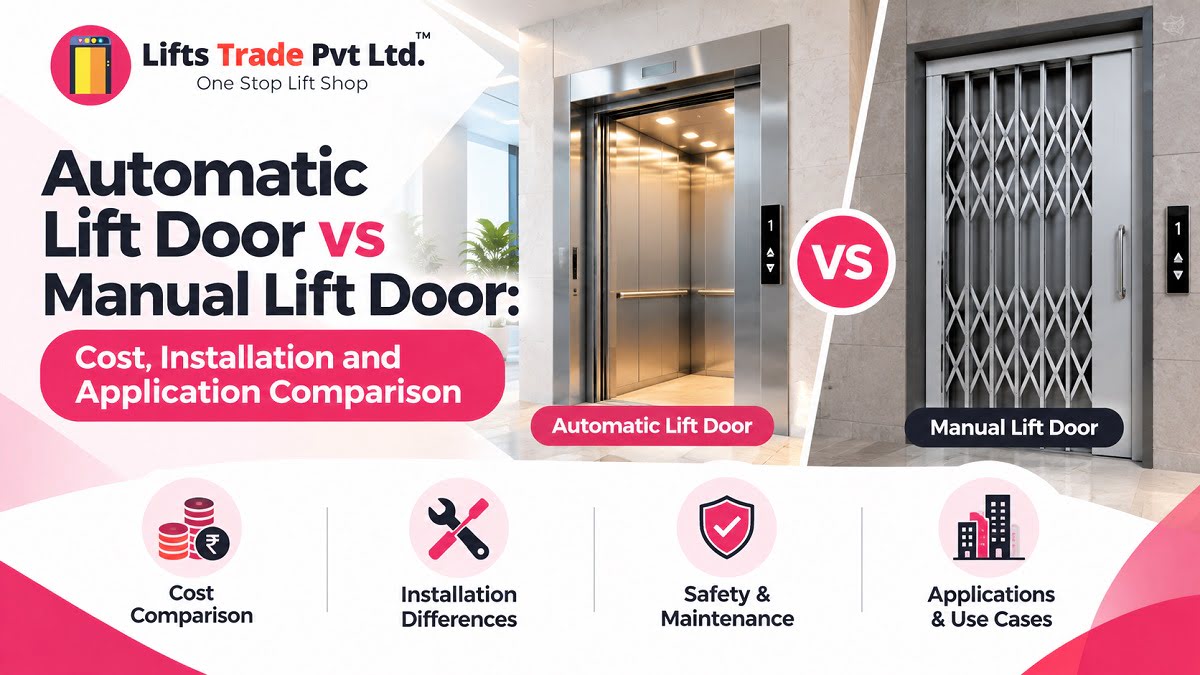
Choosing the right lift door is an important decision when installing a new elevator or upgrading an existing one. The door system affects passenger convenience, accessibility, lift operating efficiency, installation requirements and the overall project budget.
Two commonly considered options are automatic lift doors and manual lift doors. Automatic doors open and close using a powered mechanism, while manual doors require the user to operate the door by hand. Some systems combine an automatic cabin door with a manually operated landing door, offering a middle-ground solution.
For builders, architects, lift contractors, facility managers and elevator installation companies, understanding these differences helps ensure that the selected door system matches the building’s requirements.
Understanding Automatic and Manual Lift Doors
What Is an Automatic Lift Door?
An automatic lift door is a powered door system that opens and closes without passengers manually moving the door. A door operator, motor, mechanical linkage and control system coordinate the opening and closing cycle.
In many passenger elevators, the cabin door and landing door operate together when the lift reaches the floor and the safety conditions permit opening. Automatic doors may use telescopic or centre-opening sliding arrangements, depending on the lift design and available space.
Key features of automatic lift doors:
- Motor-driven opening and closing.
- Convenient entry and exit for passengers.
- Integration with the elevator controller and door safety devices.
- Options for infrared curtains or other passenger-detection systems.
- Suitable for buildings with frequent lift usage.
Automatic doors are commonly selected for apartments, offices, hospitals, hotels, shopping centres and other buildings where convenience and regular passenger movement are important.
What Is a Manual Lift Door?
A manual lift door requires a person to open or close the door by hand. Depending on the design, this may be a hinged swing door, a collapsible gate or another manually operated door arrangement.
In some lift systems, the landing door is operated manually while the cabin door operates automatically. This is often described as a semi-automatic door arrangement. Therefore, buyers should confirm whether a quotation refers to a fully manual system or a combination of manual landing doors and automatic cabin doors.
Key features of manual lift doors:
- Hand-operated opening or closing.
- Generally simpler mechanical arrangements.
- Potentially lower initial equipment cost, depending on the design.
- Fewer powered door components in some configurations.
- Suitability for certain low-usage or specialised lift installations, subject to applicable safety requirements.
Manual operation does not remove the need for appropriate door locks, interlocks and other safety provisions. The complete lift system must be designed, installed and maintained according to applicable regulations and the manufacturer’s requirements.
Automatic vs Manual Lift Doors: Quick Comparison
| Comparison factor | Automatic lift door | Manual lift door |
|---|---|---|
| Operation | Powered opening and closing | Hand-operated |
| Initial cost | Usually higher | Often lower |
| Passenger convenience | High | Depends on door design and user effort |
| Accessibility | Generally easier when correctly designed | May be difficult for some users |
| Installation | Requires operator, controls and compatible wiring | May have a simpler mechanism, depending on configuration |
| Maintenance | Includes operator, sensors and related components | Focuses on hinges, locks, tracks and other mechanical parts |
| Busy buildings | Usually preferred | May be less convenient |
| Low-usage applications | Suitable | May be considered where permitted and appropriate |
| Safety requirements | Requires correctly functioning interlocks and safety devices | Also requires suitable locks, interlocks and safety provisions |
| Long-term costs | Depends on usage, maintenance and component quality | Depends on wear, repairs, usage and door design |
Cost Comparison: Automatic Lift Door vs Manual Lift Door
Initial Purchase Cost
The initial cost of a lift door depends on more than whether it is automatic or manual. Door material, opening width, height, number of panels, finish, frame design, operator specifications and compatibility with the elevator system all influence the quotation.
Automatic systems typically cost more because they include a powered operator and associated electrical and control components. Manual systems may have a lower initial cost when their mechanical design is simpler.
However, buyers should compare complete door assemblies rather than the price of an individual door panel.
Installation Cost
Automatic door installation may require additional work for mounting the operator, aligning the door panels, connecting electrical controls and integrating safety devices with the elevator controller.
Manual door installation can be mechanically simpler in some configurations, but correct alignment, secure mounting, landing-door locking and safety checks remain essential.
The final installation cost depends on site conditions, the number of floors, the existing lift configuration and whether the project is a new installation or a modernisation.
Maintenance and Repair Costs
Automatic lift doors contain additional components that may need inspection, adjustment or replacement over time. These can include the door motor, operator mechanism, sensors, rollers, belts and related electrical parts.
Manual doors may have fewer powered components, but hinges, locks, tracks, rollers and closing mechanisms can still wear out or require adjustment.
The cost of ownership depends on traffic levels, product quality, maintenance practices, availability of replacement parts and the cost of lift downtime.
How to Compare Total Cost of Ownership
Instead of selecting a door solely on its purchase price, compare the following over the expected service life:
- Initial door and frame cost.
- Installation and commissioning expenses.
- Electrical and control integration.
- Scheduled maintenance.
- Likely replacement parts.
- Repair frequency and lift downtime.
- Accessibility and passenger convenience.
For a busy residential or commercial building, the convenience of automatic doors may justify their higher initial cost. For a low-usage application, a suitable manual arrangement may be worth evaluating if it meets all applicable requirements.
Important: Lift door prices vary by specification and supplier. Request a project-specific quotation rather than relying on a single price range for every building.
Installation Differences Between Automatic and Manual Lift Doors
Installing Automatic Lift Doors
Automatic door installation requires coordination between the door assembly, elevator cabin, landing entrances and lift control system.
Important considerations include:
- Door dimensions: Confirm the required clear opening width and height.
- Door configuration: Select a suitable telescopic or centre-opening arrangement.
- Operator compatibility: Ensure the door operator matches the door panels and the elevator system.
- Electrical connections: Confirm compatibility with the controller, power supply and control signals.
- Safety devices: Verify the required interlocks, passenger-detection devices and other safety features.
- Alignment and testing: Check smooth movement, correct closing, locking and operation at every landing.
The installer should follow the lift manufacturer’s instructions and the applicable standards and regulations. Door commissioning should include functional checks of the safety circuit and the complete door system.
Installing Manual Lift Doors
Manual door installation can involve fewer electrical connections, depending on the design. However, mechanical accuracy and safety remain critical.
The installer should check:
- Door-frame dimensions and fixing points.
- Hinge, roller or track alignment, as applicable.
- Smooth opening and closing.
- Correct operation of landing-door locks and interlocks.
- Secure mounting and suitable clearances.
- Compatibility with the lift cabin and landing arrangement.
Manual landing doors must not be treated as ordinary building doors. Their locking and interlocking arrangements must prevent unsafe access to the lift shaft and prevent lift operation when required safety conditions are not met.
What Should Buyers Confirm Before Installation?
Before placing an order, share the following information with the supplier:
- Lift type and intended application.
- Rated load and cabin dimensions.
- Number of floors and landing entrances.
- Required door opening width and height.
- Door material and finish.
- Door arrangement, such as telescopic or centre-opening.
- Existing controller and operator details, if replacing a door.
- Applicable safety and regulatory requirements.
- Delivery schedule and availability of replacement parts.
Providing accurate specifications helps reduce measurement errors, compatibility problems, installation delays and unnecessary procurement costs.
Safety and Accessibility Considerations
Passenger Safety
Lift doors are a key part of the elevator’s safety system. The correct design and installation of landing-door locks, interlocks and cabin-door protection devices are essential.
Automatic doors may offer features such as infrared detection curtains that help detect passengers or objects in the closing path. Their effectiveness depends on the equipment installed, its condition and correct configuration.
Manual doors also require appropriate safety mechanisms. A door should never be considered safe merely because it is manually operated or has a simple design.
Accessibility for Elderly Passengers and People with Disabilities
Automatic doors can make entering and exiting a lift easier for elderly passengers, wheelchair users and people carrying bags or equipment. However, accessibility depends on the complete installation, including clear opening width, cabin size, levelling accuracy, door timing and control placement.
A manually operated door may require additional effort or assistance. Where independent access is a priority, an appropriately specified automatic door system is generally worth considering.
Maintenance and Inspection
Both automatic and manual lift doors need routine inspection and maintenance by qualified lift personnel.
Checks should include the condition of door panels, locks, interlocks, tracks, rollers and associated safety devices. Automatic systems also require checks of their operators, sensors and electrical connections.
Do not bypass a faulty interlock or continue operating a lift with a defective door safety system. Arrange inspection and repair by a qualified technician.
Which Lift Door Is Best for Different Applications?
Residential Buildings and Apartments
Automatic doors are generally a practical choice for apartment buildings because multiple residents use the lift throughout the day. They improve convenience and reduce the need for passengers to handle the door manually.
For private homes and low-usage residential lifts, the choice depends on the lift design, accessibility needs, budget and applicable requirements.
Commercial Buildings and Offices
Automatic doors are typically preferable for offices, retail buildings and other commercial spaces with frequent passenger traffic. Their powered operation supports a smoother passenger flow and a consistent user experience.
Door-opening speed and configuration should be selected based on expected traffic and the elevator’s overall design.
Hospitals and Healthcare Facilities
Hospitals and healthcare buildings often benefit from automatic doors because patients, attendants, wheelchairs and medical equipment need convenient access.
The door opening, cabin dimensions and operating sequence should suit the intended use, including stretcher movement where required. Final selection should be based on the project’s accessibility, safety and operational requirements.
Goods and Industrial Lifts
Goods lifts require a door system suited to the loads being transported, loading methods, site conditions and usage frequency. Both the door assembly and the surrounding structure must be appropriate for the intended application.
Automatic or powered door arrangements may be beneficial in high-use environments, while certain specialised installations may use other configurations. The choice should follow the lift design and applicable safety requirements, not cost alone.
Existing Lift Modernisation
When upgrading an older lift, automatic doors may improve convenience and accessibility. However, replacing manual doors with automatic systems is not always a direct component swap.
The installer should assess the cabin, landing frames, shaft clearances, controller, electrical supply and safety circuits before recommending a conversion.
How to Choose the Right Lift Door Supplier
Choosing a suitable supplier is as important as selecting the door type. A compatible, well-manufactured assembly can help reduce installation issues and simplify future maintenance.
Check Product Specifications
Ask for clear technical specifications covering dimensions, material, door arrangement, operator compatibility and relevant safety provisions. Confirm that the product matches the lift’s design.
Compare Complete Quotations
Request itemised pricing for the door panels, frame, operator, sensors, control components, installation and commissioning, where applicable. This makes it easier to compare suppliers on a like-for-like basis.
Evaluate Quality and Replacement-Part Availability
Check the consistency of manufacturing, finish quality, documentation, warranty conditions and availability of replacement components. These details are especially important for contractors managing multiple lift installations.
Confirm Technical Support
A dependable supplier should be able to clarify measurements, provide product information and help identify compatibility requirements before an order is finalised.
Lifts Trade Pvt. Ltd. supplies elevator components for lift contractors, installers and other industry buyers. When sourcing lift doors or related components, buyers can use the Lifts Trade product catalogue to explore available products and confirm project-specific requirements with the supplier.
Conclusion
Automatic and manual lift doors serve different project needs. Automatic doors usually offer greater convenience and are well suited to buildings with frequent passenger traffic, while some manual arrangements may provide a lower initial cost for appropriate applications.
The best choice depends on the building type, expected usage, accessibility requirements, installation conditions, compatibility and long-term maintenance costs. Safety provisions must remain a priority regardless of the door type.
Before purchasing, compare complete technical specifications and quotations, verify the required safety features, and confirm compatibility with the elevator system. Making these checks early helps builders, lift contractors and facility managers select a door solution that fits both their budget and operational requirements.
Frequently Asked Questions
1. What is the main difference between automatic and manual lift doors?
Automatic lift doors use a powered mechanism to open and close, while manual lift doors require the user to operate them by hand. Some systems combine an automatic cabin door with a manual landing door.
2. Are automatic lift doors more expensive than manual doors?
Automatic lift doors generally have a higher initial cost because they require a door operator and associated control components. The actual price difference depends on door dimensions, materials, specifications, the number of floors and installation requirements.
3. Which lift door is better for an apartment building?
Automatic doors are generally a practical choice for apartment buildings with regular passenger traffic. They offer convenient operation and can improve accessibility when the complete lift is appropriately designed.
4. Are manual lift doors safe?
Manual lift doors can be used in suitable, compliant lift systems when they include the required locking, interlocking and other safety provisions. Installation and maintenance should be carried out by qualified lift professionals.
5. Do automatic lift doors require more maintenance?
Automatic doors have additional powered and electrical components that need inspection, such as operators, sensors and related mechanisms. Manual doors also require maintenance of their hinges, tracks, locks and other mechanical parts. Actual maintenance needs depend on usage and equipment condition.
6. Can a manual lift door be replaced with an automatic door?
In some installations, yes. However, the feasibility depends on the cabin, landing frames, shaft dimensions, controller compatibility, electrical connections and safety requirements. A qualified lift professional should assess the system before conversion.
7. What factors affect lift door prices in India?
Major factors include door material, dimensions, opening style, frame construction, operator type, safety devices, number of landings, installation work and supplier specifications.
8. What should I check before buying lift doors in bulk?
Confirm dimensions, material specifications, opening configuration, compatibility, quality documentation, warranty, lead time, packaging and replacement-part availability. Standardising specifications across projects can also simplify procurement.
9. Which automatic lift door is better: telescopic or centre-opening?
A telescopic door uses panels that slide in the same direction, while a centre-opening door separates panels toward opposite sides. The appropriate option depends on the available space, required clear opening, traffic requirements and lift design.
10. Where can I source lift doors and elevator components in India?
Buyers should compare suppliers based on technical compatibility, manufacturing quality, documentation, delivery capability and after-sales support. Visit the Lifts Trade product catalogue to explore elevator components and enquire about project requirements.